Social execution risks: a new frontier for infrastructure finance
Trillions of dollars are being invested in the infrastructure needed for the green and digital transitions. Yet projects – from wind and solar farms to, especially, data centres – are increasingly running into opposition from the communities they affect. Georgette Baliga and Arka Chanda argue that this emerging ‘social execution risk’ is becoming a material consideration for infrastructure finance.
Infrastructure projects have always faced challenges, whether technological, physical or regulatory. But mounting investment in 21st-century infrastructure appears to be running into an entirely different kind of obstacle: people.
Resistance to green infrastructure has emerged as a defining feature of the early 2020s, with blockades, protests and challenges to climate regulation steadily increasing in a number of jurisdictions. At the Just Transition Finance Lab, we have long argued that part of the problem stems from an under-emphasis on just transition needs, undermining the social acceptability on which the pace and resilience of the transition depend.
But these challenges are not limited to the green transition. The digital transition towards a world of AI, robotics and as-yet-unimagined technologies is likely to reshape people’s lives just as profoundly. As trillions of dollars flow into this digital infrastructure, its social impacts have received comparatively little attention.
At the Lab, we refer to the operational, legal and financial risks that arise from these dynamics as ‘social execution risk’. Put simply, it is the risk that projects fail because they lose the trust and acceptance needed to secure a social licence to operate.
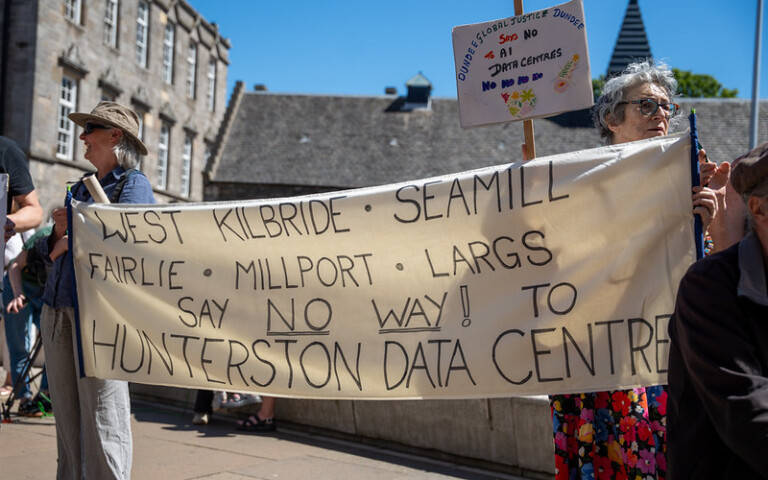
Data centre projects, in particular, have been hitting the headlines recently. A cornerstone of the digital economy, they have run headlong into community pushback, with the development of 75 projects worth about US$130 billion blocked or delayed in the first quarter of 2026 alone. Much of this follows a recognisable pattern: communities learning about a project through rumour rather than from the developer; consultation that is rushed, tokenistic or poorly attended; grievances left to accumulate unresolved; engagement that ends once permits have been secured; and protest or litigation becoming the principal means by which communities are heard. For a striking number of data centre projects, this sequence reads less like a cautionary tale than a description of events.
Why projects need more than permits
The concept of a ‘social licence to operate’ is central here. A project may secure all its required regulatory licences and permits, and yet still struggle if it lacks community trust and social acceptance.
The term was popularised in the 1990s in the mining sector, recognising that regulatory approval alone was not enough, public opinion and social acceptance should also matter to project developers. The costs of failing to secure community trust are well-documented in the extractives industry, and several mining projects have been blocked by public opposition, including Rio Tinto’s proposed lithium mine in Jadar, Serbia.
Even renewable generation, long regarded as the poster child of sustainable infrastructure, is increasingly encountering community resistance, with delays and disruption potentially costing developers millions. By contrast, investment in participatory approaches that secure community buy-in has often resulted in faster and smoother project development. Burgenland’s participatory roundtable approach to wind-power zoning is one example.
Individual projects must secure their own social licence to operate. But when many similar investments are deployed at once – as with the green and digital transitions – perceived legitimacy also matters at the industry level. A UK-wide review of community engagement for wind farms finds, for example, that poor siting decisions and inadequate engagement on earlier projects can leave developers feeling as if they are “on the back foot” with communities.
The same is true for data centres, where even mention of the term has become highly polarising.
When social impacts become financial risks
All of this matters not only for communities and policymakers, but also for investors. The AI boom is being fuelled by institutional capital and unprecedented levels of debt. Yet even as its success depends on the delivery of physical infrastructure projects, the ways in which social impacts drive risks to their delivery remain poorly understood.
This idea is not entirely new. In many cases, companies already consider the social implications of their activities at the project level, including in relation to decarbonisation. The challenge is that these considerations are rarely translated into business-level risks or made clear to the investors financing them.
Addressing this challenge requires an understanding of its underlying drivers, which vary considerably across locations and sectors. For example, a data centre in Arizona may face opposition over water use, whereas a data centre in Virginia is more likely to encounter concerns about impacts on energy prices.
The drivers may differ, but the way opposition manifests is often remarkably similar: through community mobilisation, voter pressure, political resistance across different levels of government, or reputational damage that triggers concern among internal stakeholders. The result is the same: projects are disrupted, delayed or, in some cases, cancelled. For data centres, this slows the transition to the digital economy while imposing potentially significant costs on developers and their investors. Across multiple projects, or for flagship investments such as Oracle’s Project Jupiter, the financial impacts can be significant.
Building trust before conflict
But simply looking at how projects are being disrupted and delayed is not enough. By the time widespread opposition emerges, the opportunity to manage the risk effectively has often already passed.
Prevention is key. That requires developers to engage early and meaningfully with communities and workers. Understanding local needs and anticipating how a project may affect people’s lives before construction begins is often the difference between earning trust and facing opposition.
For data centre developers, this means understanding how their projects may affect local communities, whether through pressures on energy and water resources, heat generation, air pollution or climate impacts, and addressing these concerns in the planning stages of project development.
Some jurisdictions are beginning to address these concerns directly. In August 2026, Pennsylvania Governor Josh Shapiro signed an executive order requiring data centre developers to bear the full cost of power needed for their projects rather than pass it on to ratepayers. The order also requires developers to engage transparently with local residents and leaders, hire and train local workers, and meet stringent environmental and water conservation standards, with permits contingent on compliance. Further, it prohibits the use of non-disclosure agreements in data centre projects, directly targeting the kind of secrecy that has eroded trust elsewhere.
There is no one-size-fits-all solution. Yet in the race to build as much computing capacity as possible over the coming decade, social impacts remain at risk of being overlooked. This is not costless. The mining and renewable energy sectors learned that lesson the hard way. Data centres appear to be heading down a similar path, but they do not need to repeat the same mistakes.
What investors should be asking
Investors can play an important role in helping data centre developers adopt more sophisticated approaches to community engagement and support the emergence of genuinely ‘community-first’ developments. While many developers have pledged to be good neighbours, and some have delivered on that promise, there remains significant scope to raise the baseline across the sector.
Investors, particularly those active in private credit, private equity and infrastructure markets, are well placed to share examples of good practice and encourage higher standards across their portfolios. As opposition to data centre development grows in some locations, building community goodwill and maintaining public support is no longer simply a matter of corporate responsibility. It is increasingly material to project delivery and financial performance.
As beneficiaries of the opportunities created by the digital transition, investors also have a stake in ensuring that it unfolds in a way that is socially sustainable. This means taking a more active role in assessing how community concerns, local impacts and public perceptions may affect the projects and companies in which they invest. It also means engaging their portfolio companies on how these risks are identified, managed and reported, while looking for opportunities to create shared value for both communities and investors.
Formal approaches to assessing social execution risk at the portfolio level will take time to develop. In the meantime, stewardship and engagement remain powerful tools to catalyse change. Simply asking the right questions could be a meaningful step in the right direction.