A market-led approach to the first just transition-integrated bonds: demonstrating the art of the possible

Developing guidance on the form just transition-integrated bonds could take is a key focus for a Community of Practice facilitated by the Just Transition Finance Lab and 103 Ventures. In this commentary, Arka Chanda discusses how green bonds have moved from crucial ‘demonstrator transactions’ to scale-up, and how this pathway could be replicated for the first just transition-integrated bonds.
Few industries have embraced self-regulation in the same way as sustainable finance. From the Principles for Responsible Investment to the various Taskforces – on Climate, Nature, and Social and Inequality-related Financial Disclosures (TCFD, TNFD, TISFD): industry-led, voluntary frameworks for good practice and disclosure increasingly form widely accepted benchmarks.
Voluntary approaches do not always work, but one of the reasons they sometimes can is the relational nature of the industry, which keeps a close eye on emerging market practice and reputation. For example, peer pressure and reputational concerns were some of the greatest drivers of adoption for the Equator Principles (a benchmark for assessing and managing environmental and social risk in projects). Similarly, investor sentiment and ‘sentiment contagion’ are documented factors influencing investment in sustainable debt, or so-called GSS+ (Green, Social, Sustainability, and Sustainability-Linked) bonds: another market created and maintained by voluntary, market-led frameworks.
This market-led approach can, in theory, be applied to other sustainability issues. At the Just Transition Finance Lab, we are interested in how this approach can enable the integration of just transition into financial markets. Our Community of Practice on Just Transition and GSS+ Bonds, convened with 103 Ventures, focuses specifically on how just transition can be built into the issuance of sustainable debt instruments.
This ambition is not without precedent: green bonds show that a market-led shift from niche to mainstream has happened before and offers a useful template for how it might happen again.
The green bond story
Green bonds are a compelling example of how new practices can go from niche to normal, while integrating non-financial (in this case, environmental) concerns.
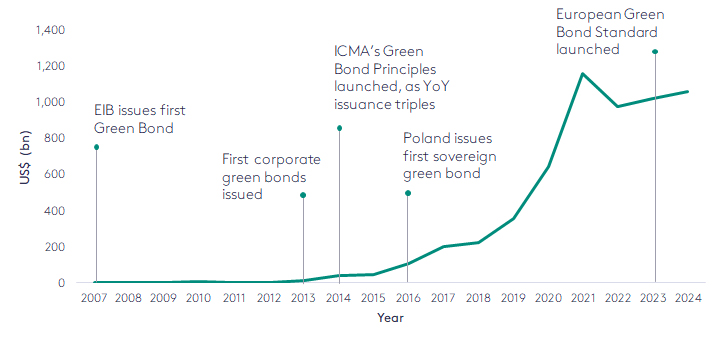
The European Investment Bank (EIB) issued the first ever green bond, called the Climate Awareness Bond, in 2007. The first corporate issuance happened in 2013 (see Figure 1), while the first sovereign issuance followed in 2016 from Poland. The GSS+ market expanded rapidly from that point, reaching over US$1 trillion in annual issuance by 2021.
But the successes of green bonds are underpinned by more than just market size. The evidence suggests that, given solid reporting requirements are in place, green bonds reduce greenwashing behaviour, have positive spillover effects, and are associated with emissions reductions.
Figure 1. Annual GSS+ bond issuance (US$ bn) with key milestones
Sources: World Bank Data; Chousa et. al (2021)
Is there a secret sauce? A perfect storm, and the demonstrator effect
The meteoric ascent of the green bond market is unprecedented precisely because it was able to overcome an age-old catch-22: relatively low levels of initial ambition on environmental issues, driven by the difficulty in ascertaining impact, and uncertain returns on the costly actions necessary – with no market precedent. The just transition faces a similar set of barriers today.
But the green bond story is as much about concentrated, industry-wide intention as it is about a perfect storm of events.
The signing of the Paris Agreement on climate change in 2015, for example, provided an important policy signal for investment and support for green technologies. Where the market started to fret about the ‘green-ness’ of the projects they were financing, the ICMA Green Bond Principles and paradigms for verifying and monitoring greenhouse gas emissions targets, including the Science Based Targets Initiative, helped allay those fears.
Three factors were central to scaling up the market: policy-backed demand for green goods and services, investor appetite for environmental impact, and guidance on measuring and verifying this impact. Perhaps, though, the most important actions were taken before the market grew. The first, pioneering, ‘demonstrator transactions’ were arguably what laid the foundations for the market’s success.
Precedents are key in creating any kind of change, and demonstrator transactions provide this, showcasing the art of the possible. Put simply, they show that something new and daunting is actually feasible, which then sets the stage for replication, and eventually, scale.
The benefits of demonstrator transactions are difficult to quantify and largely anecdotal, but the role of development finance institutions, like the EIB, in demonstrating how a green bond could work is hard to dispute. A recent study also shows evidence of demonstration effects from green bonds in China, suggesting that new issuance induces more issuance through ‘green imitation’ effects.
Riding the just transition wave
But why do this for just transition? Crucially, all investments in the green economy inherently impact people: workers, communities, and the end-users of green energy and products. And while the environmental and emissions-related impacts are accounted for in green bond frameworks and reporting, their social impacts, despite narrative-level commitments, remain ‘lost in translation’.
This should matter for investors: there is emerging recognition of just transition-related risks and opportunities as financially material. This is evidenced in growing litigation on just transition grounds, operational risks to green projects, and the systemic risks introduced by the interaction of climate and social factors.
The just transition is increasingly in policy focus, too. The International Labour Organization finds that 79% of countries reference just transition explicitly in their national climate commitments. Plus, the announcement of the Just Transition Mechanism at the UN COP30 climate conference is an important international signal for just transition issues.
As the world moves from announcements to the implementation of climate commitments, the social impacts and opportunities emerging from this process should be reflected in how the transition is financed. A just transition-integrated GSS+ bond could offer investors visibility of the social dimension of transition projects, and how they impact not just communities and workers, but also project execution.
Getting the ball rolling
Currently there is an absence of clear guidance on what it means for a bond to credibly and meaningfully account for just transition issues. Bridging this gap is an important first step to accelerate the issuance of the first just transition-integrated bonds.
At the Lab, in partnership with 103 Ventures and a dedicated Community of Practice, this is what we are working on right now. Our next step is to support the issuance of the first just transition-integrated bonds, working with pioneering issuers and cornerstone investors.
Developing guidance and making the first few transactions matters, but scale and durability of this market are crucial, too. These fall beyond what voluntary, market-led initiatives can address on their own. Eventually, there will be a need for regulation, standards and policy signals to step in, like the standards that coalesced around green bonds through the late 2010s that enabled the market to grow.
But it is difficult to scale up practice that does not yet exist. First, we need to get the ball rolling.
This commentary has drawn on discussion and insights from the Just Transition Finance Lab and 103 Ventures’ Community of Practice on Just Transition and GSS+ Bonds. The Community, co-chaired by Nick Robins and Simon Bond, aims to provide practical guidance for issuers and investors to ensure that just transition commitments are fully translated into bond realities, looking across the full suite of sustainable debt instruments, including green, social, and climate transition bonds.
The authors would like to acknowledge and thank the Community of Practice members, including the co-chairs, for the dialogue and feedback that contributed to this commentary.