Climate-related food inflation and social risks: economic and financial sector implications

Download the report here
Social risks are underexplored in mainstream climate change analysis and largely excluded from the analytical work of institutions such as the Network for Greening the Financial System (NGFS). Yet they are widely recognised as a material consequence of climate change. The Intergovernmental Panel on Climate Change (IPCC), for example, has linked climate change to adverse outcomes including food insecurity, migration and conflict.
Social risks are the potential adverse effects of events or circumstances on the welfare of individuals and societies, and on the stability and cohesion of the social fabric. They range from effects on jobs, income, assets, education and health at the individual level, to broader ‘social-macro’ consequences such as social and political instability, civil unrest, migration and conflict.
This report provides an initial investigation of climate-related social risks and their consequences for the economy and financial sector, focusing on one salient risk – climate-related food price inflation. It aims to contribute to efforts to better understand and incorporate social risks into climate change discourse and the analytical work of relevant international bodies.
Key findings
- The empirical evidence base linking climate change, food insecurity and conflict is fragmented but indicative.
- Social risks can affect macroeconomic growth and financial stability in diverse ways, including through suppressed productivity and human capital accumulation, deterred foreign direct investment, reduced sovereign creditworthiness and wider sovereign spreads and a higher probability of banking crises.
- Low-income countries and lower-middle-income countries are most vulnerable to these risks.
- High-income countries are not insulated against such risks and may be affected through various potential spillovers, including cross-border supply chain disruption, contagion in financial markets, disorderly migration and import-driven food price pressures.
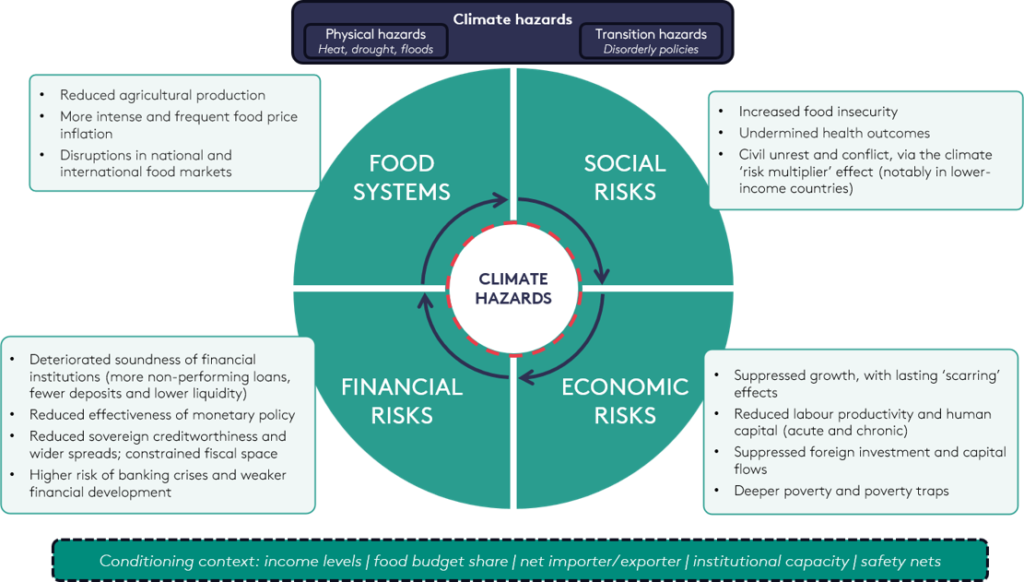
- The authors propose a nexus-based analytical framework (reproduced below) to capture the compounding interactions between climate change, food price inflation, conflict and adverse economic and financial outcomes, and identify a need to more fully integrate climate-related social risks into the analytical work of relevant international bodies.
DOI: 10.21953/researchonline.lse.ac.uk.00140166