A just transition for all: can Europe’s new funding model deliver?

As Europe enters a pivotal stage in negotiations over the EU’s next seven-year budget, with the aim of delivering more competitive, flexible and simpler funding, Carlota Pombar considers the implications for the Just Transition Fund and what could be lost if dedicated support disappears.
The EU is considering a more flexible and simpler approach to cohesion funding – funding designed to support economic and social balance across the EU – giving national governments greater discretion through new National and Regional Partnership Plans (NRPPs). The vehicle for this new approach is the 2028–2034 Multiannual Financial Framework (MFF), which is expected to be agreed in early 2027. The Commission aims to move away from dedicated funding instruments towards a more integrated funding model, with potentially significant implications for the Just Transition Fund (JTF), including the possibility of losing it as a standalone instrument beyond 2027.
Mainstreaming just transition
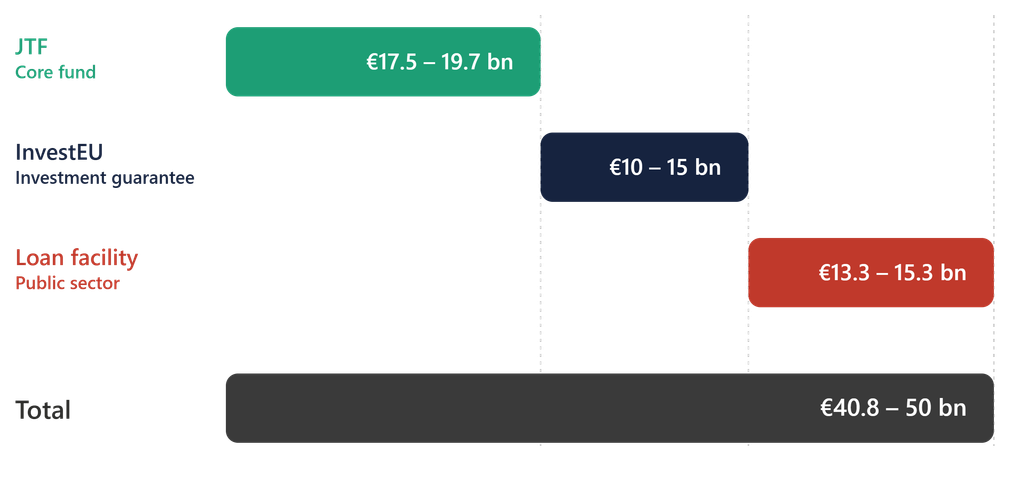
The EU’s Just Transition Fund (JTF) was created for the 2021–2027 MFF as a dedicated instrument providing targeted support for territories most exposed to the socioeconomic consequences of phasing out coal and other carbon-intensive activities. As the first pillar of the Just Transition Mechanism (JTM) under the European Green Deal, the JTF was expected to mobilise around €27 billion (Figure 1). Its dedicated status provided a specific funding channel for territories facing particularly concentrated costs from the transition.
Figure 1. Just Transition Mechanism Structure, 2021–2027
(Data source: European Commission, visualisation by author)
The Commission’s proposal for the next seven–year budget responds to pressing challenges such as defence and enhancing the EU’s competitiveness. But it also reduces the prominence of several priorities that were more explicitly protected under the previous budget, including the just transition.
The proposal would centralise most of the fund management at the national level through NRPPs, replacing the previous multi-fund territorial plans and reducing the extent to which resources are earmarked across programmes. Cohesion Policy, the common agricultural policy (CAP) and related instruments would be brought together within a single plan per member state, with fewer predefined allocations. The JTF would be discontinued altogether under the proposed MFF framework (Figure 2). While this would not necessarily remove EU support for the just transition, it would change how it is prioritised, negotiated and delivered. Territories particularly exposed to the socioeconomic impacts of transitioning away from high-emission industries could be competing for resources within a much wider set of objectives.
Figure 2. Multiannual Financial Framework 2028-2034
(Data source: Publications Office of the European Union)
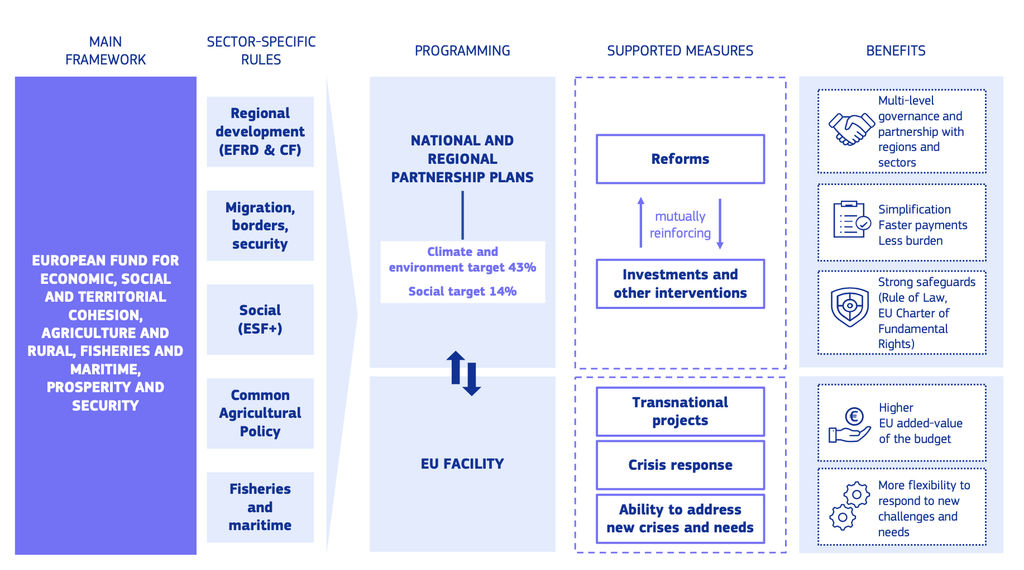
The proposed MFF framework includes a binding 14% allocation of relevant NRPP expenditure to social objectives in addition to a ring-fenced minimum of around 28% (€218 billion) for less-developed/low-income regions. However, it is unclear whether this offers enough visibility or protection for areas facing concentrated just-transition costs, especially since final allocations will still be shaped by national NRPP negotiations. The implications are clearer when you consider the relationship between just transition and the wider objectives of the EU’s Cohesion Policy.
Cohesion, territory and the green just transition
The JTF sits within a broader EU policy tradition of addressing territorial disparities through Cohesion Policy. Rooted in the Treaty on the Functioning of the EU (Articles 174, 176 and 177), Cohesion Policy is designed to reduce regional disparities and support less developed regions. This reflects its wider role in strengthening territorial cohesion and, as Rodríguez-Pose, Professor of Economic Geography at the London School of Economics puts it, acting as the “glue that binds the EU together” — a role that Kata Tüttő, President of the European Committee of Regions, has similarly described.
The regional disparities Cohesion Policy was designed to address, however, have not disappeared. While countries such as Poland have narrowed the economic gap with others such as Germany and France, regional disparities within member states have persisted. Capital cities and major urban centres have pulled ahead, while peripheral regions have faced weaker economic opportunities. Economic convergence between countries has therefore not necessarily translated into convergence across all regions.
While the just transition is a more recent policy concern, the underlying challenge is similar: structural change does not affect all territories equally. Territories dependent on carbon-intensive industries, energy production and related supply chains face greater risks from employment losses, economic restructuring and social disruption. The green transition is therefore very much part of the territorial dynamics addressed by Cohesion Policy.
The JTF’s implementation since 2021 has been uneven, but it has nevertheless established a dedicated and identifiable channel of support for regions particularly exposed to the transition. This dedicated support is now at stake in the wider redesign of the EU budget.
In July 2025, the Commission proposed bringing the European Regional Development Fund, European Social Fund Plus (ESF+) and Cohesion Fund together under a single NRPP instrument. While this could increase flexibility, it may also make distinct territorial needs less visible and leave regions most effected by the transition with less targeted support, a problem that the JTF was originally designed to address.
Who decides? The institutional debate over the JTF
The future of the JTF has become a significant point of disagreement between EU institutions. Parliament has raised concerns about the Commission’s proposal to absorb cohesion instruments into NRPPs, arguing instead for a place-based approach, stronger regional involvement and dedicated support for vulnerable territories. In March 2025, the Committee on Regional Development called for the JTF to remain fully integrated into the Common Provisions Regulation, preserving dedicated support for reskilling, future sectors and vulnerable territories and rejecting a one-size-fits-all approach. In October, four European political groups reinforced this position, warning against making a single national plan the basis for shared-management spending after 2027.
The Council has yet to establish a clear position on the future of the JTF. Civil society and the European Economic and Social Committee have called for the JTF and ESF+ to remain standalone instruments with stronger local involvement. The European Trade Union Confederation has warned that greater national management of EU funding, combined with cuts and increased centralisation of cohesion funds, risks weakening stakeholder participation and leaving vulnerable regions without dedicated support, underscoring the need for binding EU legislation on just transition to ensure a level playing field. The institutional debate ultimately turns on the extent to which greater national flexibility can be reconciled with sufficient protection for territories facing concentrated transition costs.
The risk of a competitive but place-blind green transition
At stake is more than institutional design; it is the visibility and protection of territorial priorities within a broader national framework. High emission regions enter the transition from different economic, social or institutional starting points, and have different capacities to manage it. Where institutional capacity is weaker, limited resources can constrain investment and implementation, reinforcing existing disadvantages.
A place-based approach recognises that there is no one-size-fits-all pathway to transition. Dedicated funding and strong local involvement can provide the continuity needed to build capacity and deliver results. But territorial equity is not the same as social equity. Reducing regional disparities does not automatically ensure that workers and communities benefit equally from economic convergence. A just transition therefore needs to address both territorial capacity and the distribution of the costs and benefits of change.
The shift towards competitiveness in the EU’s policy agenda makes this territorial and distributive dimension particularly important. Strengthening industry, productivity and innovation should mean investment in regions undergoing structural change, but that investment is not guaranteed. Even where it materialises, it does not by itself ensure that structural change works for the people living through it. The risk is that just transition becomes just competitiveness: supporting firms and sectors to adapt while assuming social benefits will follow. The concept of geographies of discontent shows what is at stake if they do not: economic stagnation and a sense of being neglected by institutions is already concentrated in many of the same places experiencing structural change. Competitiveness-first investment, unless accompanied by measures that ensure its benefits reach affected territories and communities, risks reinforcing that pattern.
A distributive guarantee of this kind is what distinguishes a just transition from the transition alone. Namely, it goes beyond making regions and firms greener and more productive to ensuring that affected workers and communities are better off because of the transition. The post-2027 architecture will be critical in maintaining that distinction.
Making just transition work
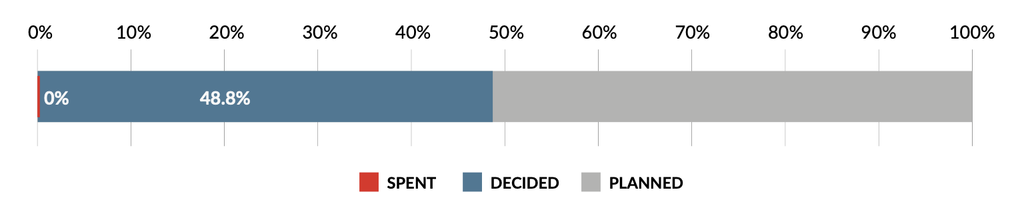
Spain and Sweden provide useful examples of how the just transition can operate when funding is connected to institutions, territories and affected groups. Spain demonstrates the importance of long-term planning and place-based governance. Its coal transition has been supported by a national Just Transition Strategy, a dedicated Just Transition Institute and Just Transition Agreements bringing together different levels of government, trade unions and civil society. With 96% of JTF funding managed by the regions, the model gives territorial authorities a substantial role in implementation. At the same time, slow disbursement shows that effective governance also requires coordination, administrative capacity and delivery mechanisms (Figure 3).
Figure 3. Spain’s JTF expenditure process
(Data source: Bankwatch Network and Forum Energii)
Sweden provides a different example, in which just transition builds on established industrial and social institutions. JTF funding supports the decarbonisation of steel, metals and cement, while Job Security Councils help workers retrain and move into new employment as industries restructure.
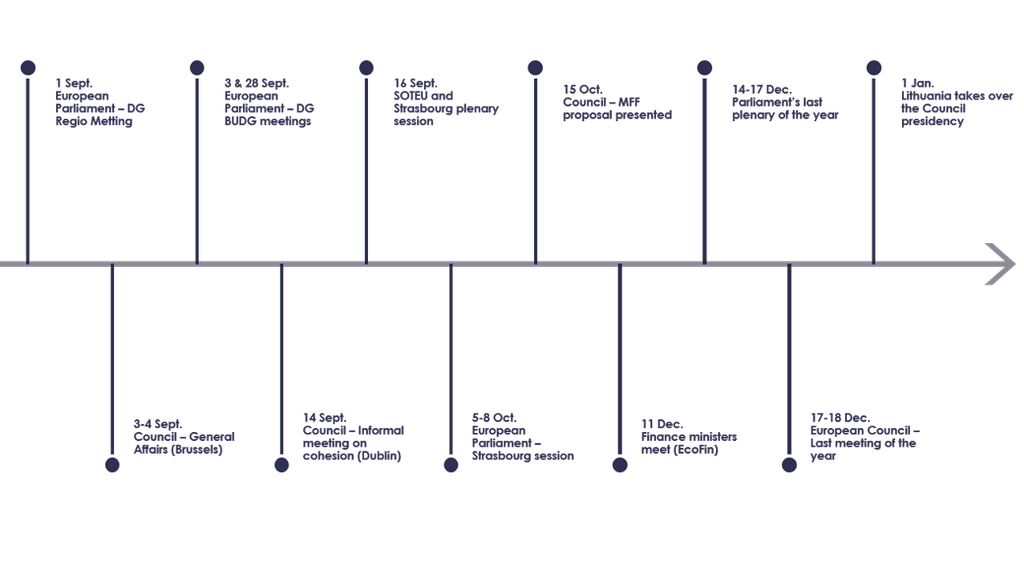
These examples show that just transition is not only about funding, but also about institutional capacity, territorial ownership and mechanisms that connect investment to the needs of affected workers and communities. But it’s now September. The political rentrée is behind us, and the pressure to reach a deal is mounting in Brussels. As the MFF negotiations move forward (Figure 4), the central question is not simply about the future eligibility of just transition for EU funding after 2027. Instead, there is a more fundamental concern over whether under its new funding model, the EU is able to retain sufficient territorial focus and institutional capacity to ensure that regions facing the greatest costs of transition are able to participate in, and benefit from, Europe’s economic transformation.
Figure 4. Multiannual Financial Framework timeline post-September 2026. (Data sources: European Parliament, Council, European Commission, visualisation by author)