


How Europe’s coal regions could be affected by the proposed redesign of the EU’s budget framework
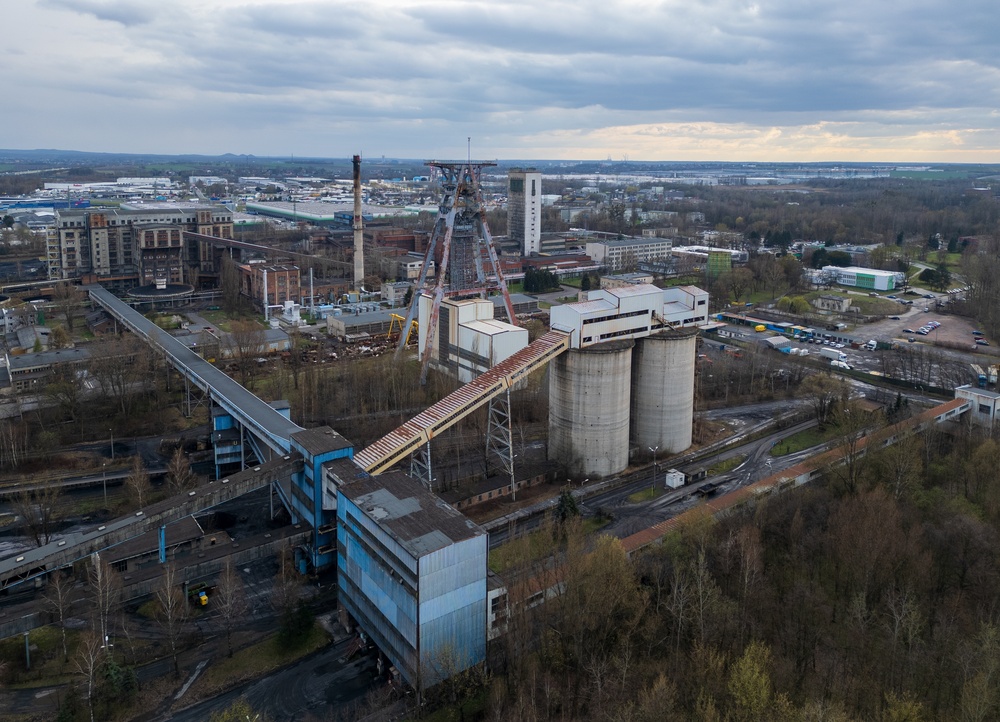
Alexander Weston examines the proposed redesign of the EU’s long-term budget, the Multiannual Financial Framework, and its implications for Europe’s just transition. The loss of dedicated just transition architecture would affect both fossil-fuel-producing regions that have received just transition funding to date and those facing phaseout that have remained outside the fund’s support – though a shift to integrated national planning could also provide opportunities.
The European Commission’s proposal for the new Multiannual Financial Framework (MFF) comes as the EU’s policy agenda increasingly prioritises flexibility, simplicity and the need to address competitiveness amidst geopolitical and economic challenges. Accordingly, Cohesion Policy and Just Transition Policy would be restructured through several changes, including a reduction in thematic ring-fencing in general and removal of the Just Transition Fund (JTF) in particular, alongside a shift to give national governments broader discretion over programming via National and Regional Partnership Plans (NRPPs).
Why just transition support matters
Research on ‘left-behind-places’ – including the manufacturing regions of the US exposed to the China trade shock and the coal-mining regions affected by the post-1980 decline of US coal employment – has shown that the costs of concentrated local economic shocks, in the absence of effective adjustment policy, can be comprehensive. This includes a decline in local employment and a rise in public expenditure on transfers, the rise of individual and community deprivation, as well as a rise in political polarisation.
In Europe, the combination of long-term structural factors and external economic shocks producing regional stagnation or decline has generated a ‘geography of discontent’ characterised by declining trust in institutions and resistance to core EU values including the free movement of capital and people. Given that the transition to a low-carbon economy is expected to have concentrated adverse effects in fossil-fuel-producing territories, there is growing recognition of the potential emergence of pockets of discontent about green policy in regions where the transition is inadequately supported.
The risks could therefore likely be particularly acute where dedicated transition support is absent. In this context, the proposed changes to the MFF, including the removal of the Just Transition Fund, could reduce the salience of just transition as a distinct policy objective, remove the earmarking of funds for that purpose, and give national governments greater discretion over programming, raising questions about how regions can be adequately supported in the absence of dedicated EU architecture. This concern is especially true for regions excluded from the current fund, such as those surrounding the Turów and Bogdanka coal mines in Poland.
Before looking further at the proposed new MFF and its implications, it is useful to explain how the Just Transition Fund has worked to date.
How the Just Transition Fund supported climate-neutrality in the EU
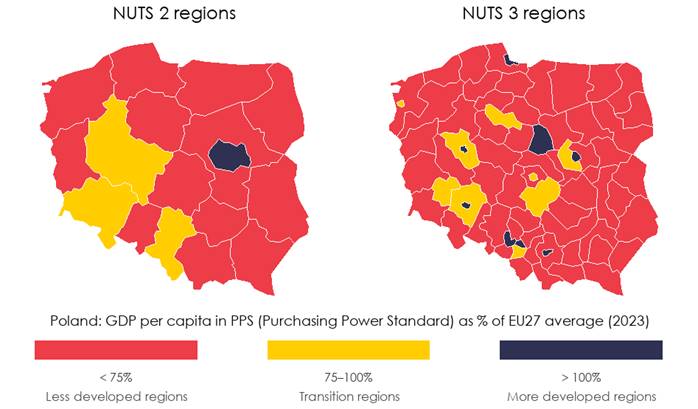
The Just Transition Fund was introduced in 2021 as the central grant instrument of the EU’s Just Transition Mechanism, intended to address the economic, social and environmental impacts of the transition to climate neutrality. The fund operates by requiring member states to identify eligible regions in consultation with the European Commission, and to produce Territorial Just Transition Plans (TJTPs), outlining the challenges in each territory, their phaseout timelines and their proposed use of funds. A distinctive feature of the JTF is that eligible territories were designated at a finer geographical scale than usual, the NUTS-3 level (small regions generally with a population of 150,000 to 800,000), rather than the broader NUTS-2 scale that typically defines the boundaries of regional policy. This finer resolution in principle allows the fund to capture and monitor the local conditions and regional variation that broader categories obscure – see Figure 1.
Figure 1. Poland: The NUTS-3 analysis (right) adopted in the JT Fund provides greater insight into regional GDP disparity compared with standard NUTS-2 practice (left), which can obfuscate intra-regional variation (Data source: Eurostat; visualisation by author)
Beyond its dedicated funding allocation (€17.5 billion in 2018 prices) the JTF operated through a distinctive governance architecture centred on the Territorial Just Transition Plans. These are strategic documents prepared by each eligible region in collaboration with local actors such as representatives of municipalities, trade unions, civil society, academia and industry. These groups worked to identify specific regional characteristics and challenges, and to develop potential roadmaps for economic development amidst a managed fossil fuel phase-out (see for example the TJTP of Silesia [available in English]). The Plans were meant to ensure that transition efforts remained inclusive, promoted the necessary local ownership and buy-in, and kept the specific needs of affected communities at their core.
Although this governance architecture represents an example of the administrative complexity that the proposed new funding framework seeks to eliminate, it was through this mechanism that institutional capacity for transition planning was built. For example, in Poland, TJTPs developed at the voivodeship level (Poland’s highest-level regional administrative unit) were more concrete, ambitious and accurately reflective of real conditions than the national-level strategies.
However, the fund’s implementation record has been uneven across member states. For example, by late 2025, Poland had committed around 73% of its JTF allocation and disbursed around 12.5%, compared with nearly 49% committed in Germany and 38% in Romania. Administrative complexity, difficulties managing multiple fragmented EU funding sources, capacity constraints and state aid rules caused delays and project quality issues in several countries. In some cases, civil society organisations were consulted only at late stages rather than meaningfully involved in early planning, and decision-making on strategic projects lacked transparency.
Proposed changes to Europe’s just transition funding
The proposed new framework entails four substantive changes to the current architecture.
First, the proposal consolidates all EU shared-management funds, such as the European Regional Development Fund (ERDF), the Cohesion Fund (CF) and the European Social Fund Plus (ESF+), into a single instrument. While these funds formally remain, none retain a dedicated budget. Importantly, it is proposed that the JTF be removed entirely with no standalone successor – see Figure 2.
Figure 2. The European Commission’s proposed redesign of the EU’s Multiannual Financial Framework (Based on Rubio and Alcidi, 2026; visualisation by author)
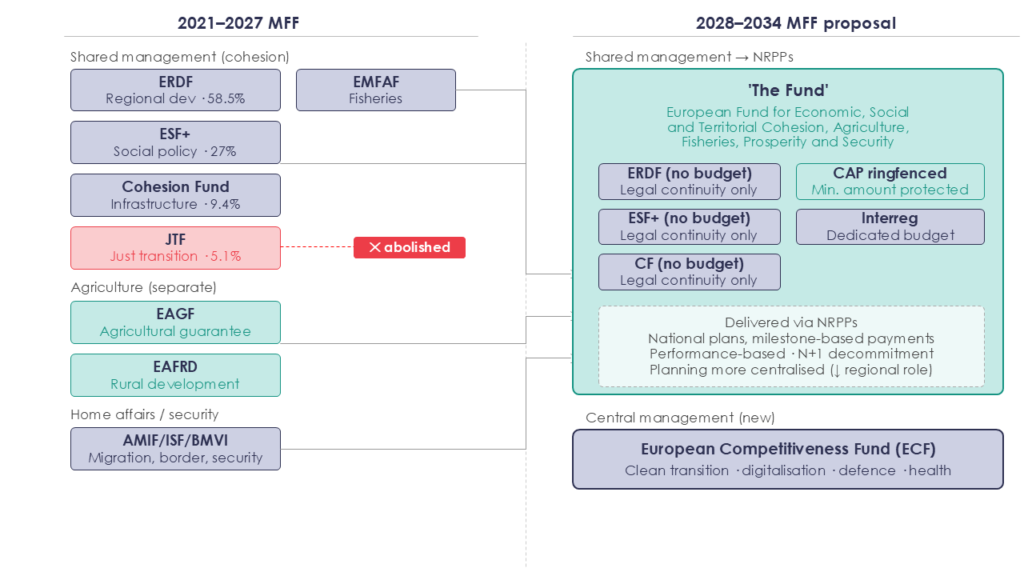
Secondly, thematic ring-fencing has been significantly reduced. Just transition loses its dedicated instrument, with transition-related investments required to compete within broader thematic envelopes, specifically a mandatory 43% climate and environmental allocation and a 14% social allocation, without any specific earmarking for just transition objectives. The combined cohesion and Common Agricultural Policy (CAP) envelope, within which the JTF previously sat, also falls by approximately 14% in real terms. Restrictions on directing funds towards objectives such as industrial and defence–industrial investments are also loosened, intensifying the competition for just transition-related investments.
Third, the single fund would be implemented by member states through National and Regional Partnership Plans (NRPPs). This centralisation of authority raises concerns as it effectively reverses the devolution to regional level that underpinned the JTF. NRPPs would be designed and negotiated bilaterally through a Commission–capitals nexus, with regional authorities recast as stakeholders rather than co-managers of the funds. This governance logic risks the loss of institutional capacity built through local ownership of Territorial Just Transition Plans – a risk that is particularly acute in Central and Eastern European member states, where formal regional transition planning was, in many cases, first catalysed through the JTF.
Many see benefits to this centralisation. Proponents point to provisions in the draft NRPP regulation requiring member states to prepare and implement plans in partnership with regional and local authorities, and allowing plans to include national, sectoral and regional chapters. However, the depth of this regional involvement remains at the discretion of national governments.
In practice, regions that previously held EU-sanctioned authority over their just transition planning must now compete for policy attention and meaningful representation within a framework designed at the national level. Where funding was once ring-fenced for specific regions and objectives, national governments now hold greater discretion over how and where consolidated funds are allocated. This complicates the assumption that devolution from the EU to the national level will, in itself, empower regional stakeholders.
Finally, the outcomes-based funding model shifts payments from cost-based reimbursement to a performance-based system in which payments are linked to the achievement of predefined milestones and targets, with the Commission able to recover funds where targets are not met. This could potentially create incentives to favour safer, easily-measurable interventions over the kind of experimental, longer-horizon action that just transition often requires.
Finding the opportunities for just transition policy in the new regime
The proposed new EU funding model presents both challenges and potential opportunities for just transition policy. Outcomes will become more dependent on how member states exercise their expanded programming discretion.
The primary challenge is the loss of dedicated just transition architecture. Without the JTF and its mandatory territorial planning requirements, just transition must compete as one objective among many within broader national spending frameworks. The place-based approach that underpinned the current Cohesion Policy, and which was central to the JTF’s effectiveness, is no longer a mandatory feature of the proposed framework, with territorial just transition strategies becoming optional.
Nonetheless, the shift to integrated national planning is not without merit. The NRPP framework offers member states greater flexibility to combine just transition investments with complementary interventions in skills, infrastructure and economic diversification within a single coherent plan, potentially reducing the fragmentation that limited the effectiveness of parallel funding streams in the current period. The performance-based disbursement model also incentivises a focus on outcomes rather than expenditure compliance, opening the door for potentially more effective performance-based just transition funding driven by the NRPPs.
——————————————————————————————
The European Policy Lab stream at the Just Transition Finance Lab will be assessing the social, economic and financial risks of an accelerating but inadequately resourced transition in ‘left behind’ regions affected by coal phaseout, exploring what financing mechanisms, including the Modernisation Fund and the incoming MFF, could be mobilised to bridge the gap. We aim to provide evidence to inform both EU and national-level policymakers in member states – starting with Poland – as they design their NRPPs and determine how just transition considerations are reflected within.