The Just Transition Mechanism: a keystone for coordination

Liam Orme and Xinyu Hong review how the emerging Just Transition Mechanism can play an important role in strengthening international support for just transition implementation. Analysing public data from the NDC Partnership, they provide insights for the Mechanism’s design as COP31 provides a chance to streamline the fragmented system of just transition support pathways.
At last year’s UN climate conference, COP30, countries agreed to develop a Just Transition Mechanism (JTM) to operate alongside existing international and multilateral support initiatives. An informal note from the June 2026 climate meetings (SB64) stated the Mechanism’s core functions: technical assistance, knowledge-sharing and capacity-building. However, it left the Mechanism’s structure open for negotiation.
This is a critical moment in the just transition where we move from words to action. In our analysis below we use data from the NDC Partnership to inform the design of the JTM. We build on recent findings from the International Labour Organization that show over 75% of countries now reference just transition in their nationally determined contributions (NDCs) and more than half commit to action. A well-designed JTM can act as the keystone for implementation: holding existing initiatives together and filling critical gaps so that the currently fragmented system of support becomes more than the sum of its parts.
Insight 1: Countries have a range of pathways to just transition support
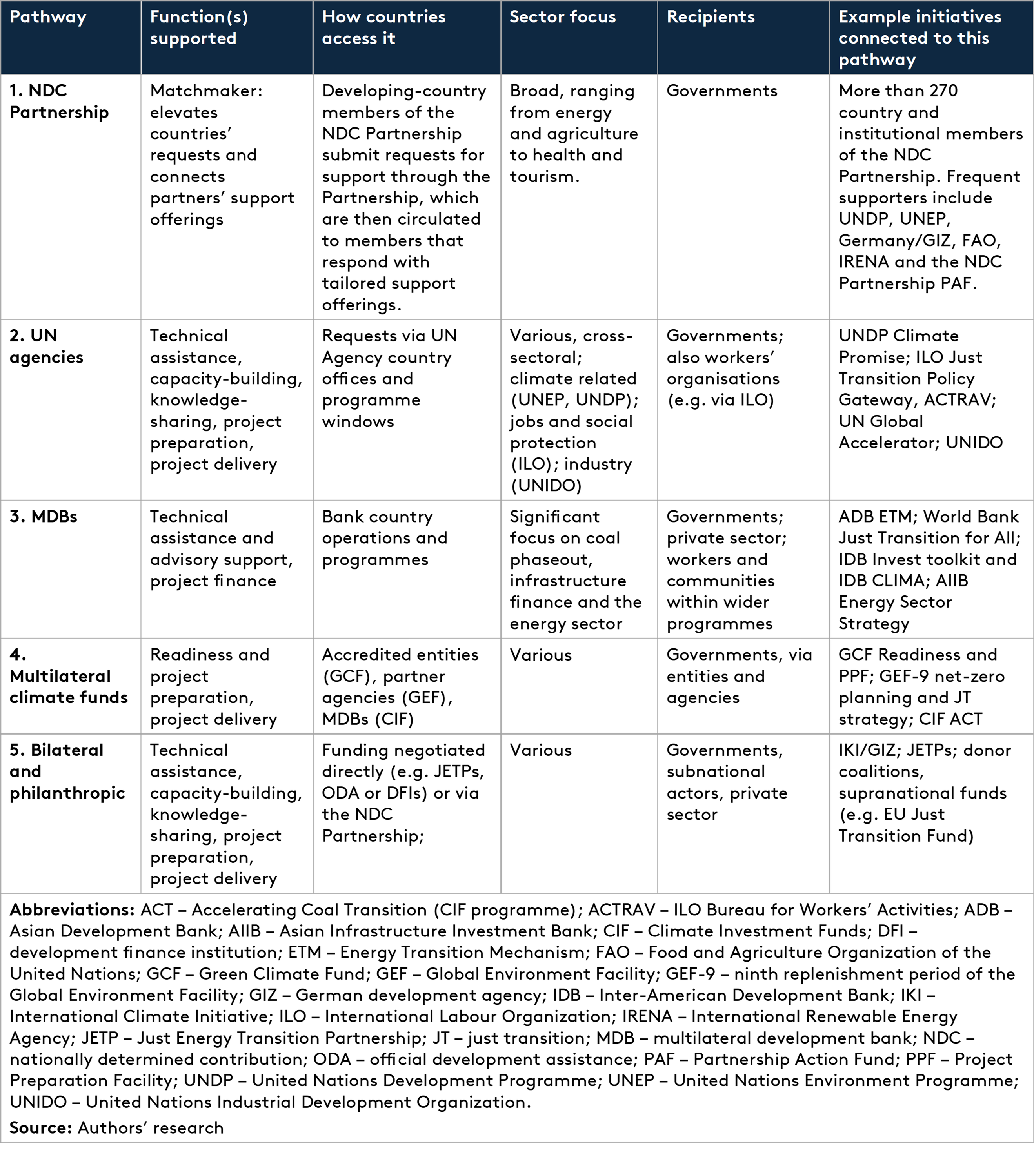
Under existing arrangements, countries access just transition support through a complex mix of pathways, as summarised in Table 1 and illustrated through the examples of Vietnam and Malawi below. Support programmes and initiatives across these pathways cover the full journey from commitment to implementation: helping countries set just transition commitments (for example through NDC enhancement support), develop project pipelines, and mobilise the resources to implement them.
Table 1. Pathways for countries to access just transition support (illustrative)
Examples of Vietnam and Malawi
Vietnam does not yet have a dedicated national framework for just transition but its government has leveraged multiple pathways to secure support for just transition-aligned priorities. Between 2018 and 2024, Vietnam submitted five just transition-related requests for support through the NDC Partnership, which have been supported by the World Resources Institute, Asian Development Bank (ADB), United Nations Development Programme (UNDP) and the German government. Separately, Vietnam’s Just Energy Transition Partnership (JETP) assembles international support via public and private financing commitments, with UNDP acting as the Secretariat Support Agency.
Vietnam is pursuing a policy-based financing programme from the Asia Infrastructure Investment Bank (AIIB), co-financed with Germany’s development bank KfW. The country also participates in the UN Global Accelerator on Jobs and Social Protection for Just Transitions, which has supported a government-led roadmap on employment, social protection and skills, while the German development agency GIZ has provided support for vocational training.
In Malawi, there are fewer parallel initiatives but a similar level of complexity. Malawi has received support for its long-term low-emission strategy via the International Renewable Energy Agency (IRENA) and the Flemish Institute of Technology Research (VITO), with funding from the NDC Partnership’s Partnership Action Fund (PAF). The UN Global Accelerator has supported Malawi’s 2024–2030 National Roadmap which led to funding to develop a proposed Workers’ Compensation Fund. Malawi has also confirmed sector-specific just transition support: via a Global Environment Facility (GEF) grant implemented by the African Development Bank (AfDB) for climate-resilient fisheries, and a World Bank initiative on just transitions in mining.
Insight 2: Countries’ demand for just transition support has grown faster than the current system can meet
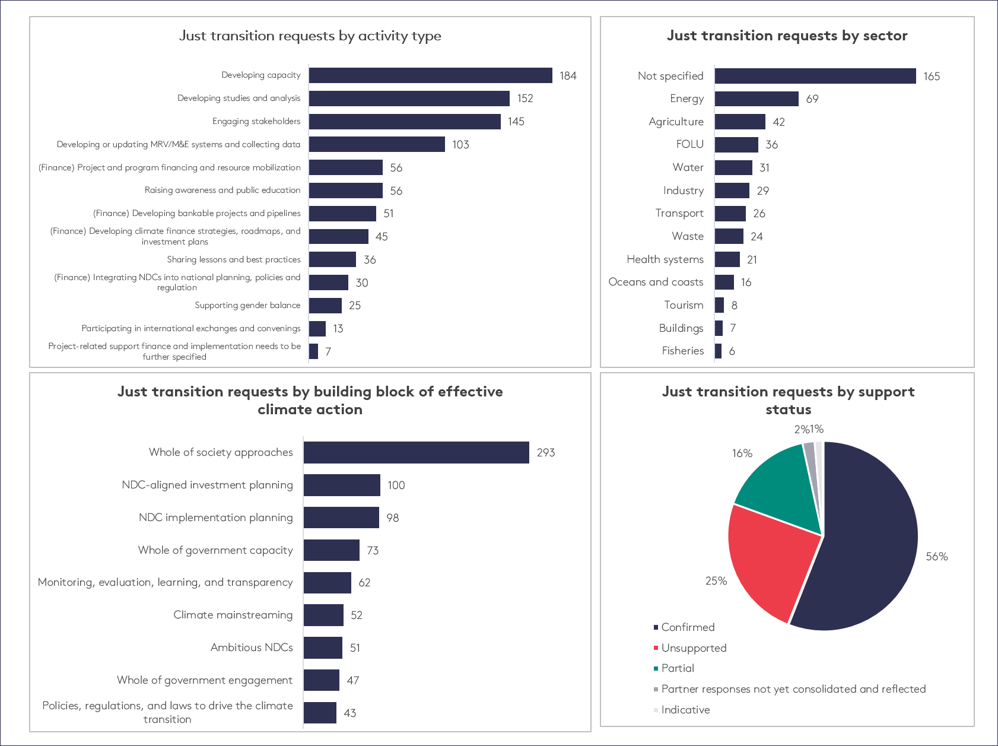
Existing pathways create a valuable patchwork of support, but evidence shows this does not yet satisfy demand for just transition support. At the time of writing 84 countries have submitted 293 just transition-related requests to the NDC Partnership, spanning a range of activities, sectors and objectives (see Figure 1; each request can bundle multiple activities, sectors, building blocks and other attributes). Sixty-three per cent of requests tagged with ‘just transition’ are crosscutting, while mitigation- and adaptation-specific requests account for 20% and 16%, respectively.
Figure 1. Summary of 293 requests submitted to the NDC Partnership between 2018 and October 2026 (type, sector, outcome of interest, support status)
Data source: NDC Partnership (accessed 26 October 2026)
The requests for support circulated through the NDC Partnership range from NDC development to implementation to access to finance. Most just transition-focused requests involve developing capacity (184 of 293 requests), technical studies and analysis (152) or stakeholder engagement (145), and around a third involve monitoring, reporting and verification systems (103). Finance-related activities span project and programme financing, developing bankable projects, climate investment roadmaps, and integrating NDCs in fiscal plans; jointly, they represent a sizeable share of requests.
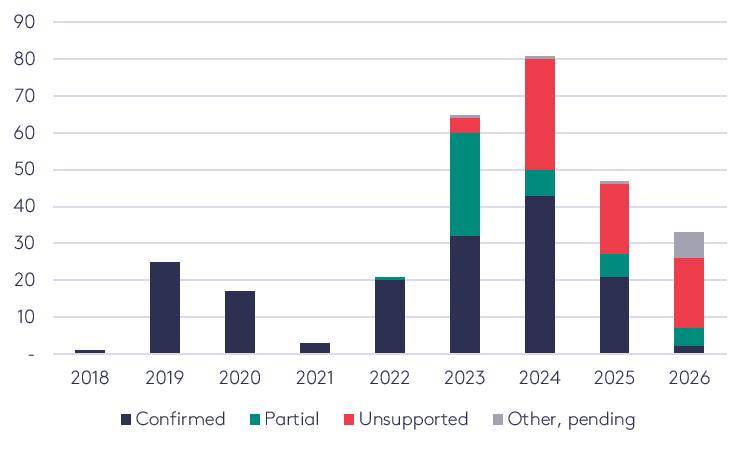
The NDC Partnership data indicate that the complexity of requests for just transition support may be growing. Comparing the total annual requests (see Figure 2) with the number of distinct activities within those requests (see Figure 3) finds less than three activities per request before 2025 but five activities per request in 2025 and 2026.
Growing demand has coincided with a widening gap between the number of requests and confirmed support (see Figure 2). The number of requests rose from 67 across 2018–2022 (almost all of which were fully supported) to 226 since 2023 (over three-quarters of the total), with under half fully supported in 2024–2025. In total, 25% of requests have not yet been supported, while a further 16% have received partial support. This mirrors broader trends across types of requests submitted to the NDC Partnership.
Figure 2. Number of yearly just transition-related requests submitted to the NDC Partnership between 2018 and October 2026 and their support status
Data source: NDC Partnership (accessed 26 October 2026)
Figure 3. Prevalence of activity types represented in yearly requests submitted to the NDC Partnership between 2018 and 2026
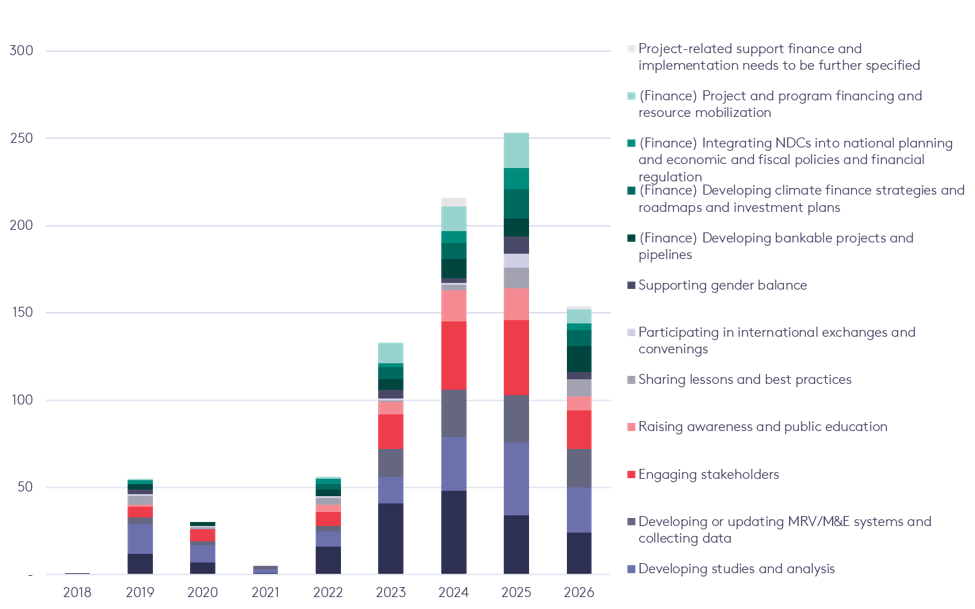
Note: one request can encompass multiple activity types. Data source: NDC Partnership (accessed 26 October 2026)
These patterns are informative for the JTM. First, the activities tied to NDC Partnership requests match the functions of the JTM, including capacity-building, knowledge-sharing and technical assistance. Second, the mismatch between requests and confirmed support illustrates the case for further support and resourcing. Third, the growing complexity of requests suggests value from coordinating across existing initiatives. Together, these points suggest the JTM can create value by helping countries and providers assemble support from many sources, and offering support for activities that are not currently well-served.
Insight 3: Just transition support offerings within each pathway are shifting
As countries start to implement their climate commitments, leading support initiatives are evolving. For example, UNDP’s Climate Promise, which supported more than 100 countries to prepare their latest NDCs, has relaunched as Climate Promise: Forward, a common framework for the UN system to support NDC implementation that embeds just transition considerations in the design of support. This updated approach has been designed to avoid the creation of parallel processes across UN system actors.
The Global Accelerator embeds similar efforts to align actors by assembling government ministries, social partners, UN agencies and development banks around government-led national roadmaps integrating employment and social protection policies and to financing needs. With related aims, the International Labour Organization (ILO) has launched the Just Transition Policy Gateway, a curated, searchable repository of national just transition policies and the social dialogue processes behind them. An accompanying Help Desk will offer countries and social partners tailored guidance and connections to a global community of practice.
While these efforts are promising, the NDC Partnership data show that further support is still needed. And while institutions are adopting a more joined-up approach across flagship programmes, each new initiative is resource-constrained, which limits its potential reach. For example, the ILO intends its Just Transition Policy Gateway Help Desk to support stakeholders in at least 10 countries by 2028. This suggests limitations in its ability to adapt resources for specific needs and contexts. Similarly, the second round of the Global Accelerator supported fewer than half of proposals (23 of 51). By comparison, more than 60 countries have requested just transition support through the NDC Partnership since 2024. These conditions suggest the ecosystem of support is structurally fragmented. In a fragmented field, coordination capacity is critical.
The Just Transition Mechanism as a keystone for implementation support
How this coordination capacity is delivered is a matter of design. A JTM that serves as another request window would likely be seen as another pathway for countries to manage, or another administrative layer. If, instead, the JTM can engage various actors to produce a clearer catalogue of the support pathways available and help harmonise across offerings and access pathways, it could reduce the administrative burden on countries seeking support and smooth the implementation of just transition policies and initiatives.
Several mutually reinforcing strategies could achieve this. These include capacity to deliver active matchmaking between countries and providers and establishing common request formats and referral protocols between support providers. This could be accomplished by extending the NDC Partnership’s approach as an emerging standard across more domains, actors and functions. The Global Accelerator also shows what this can look like in practice: its government-led national roadmaps give funders a single, structured statement of country priorities to align behind, while its published catalogue of technical services makes clear what support is on offer.
Coordination should capture not only which initiatives and pathways exist, but also how much capacity each has to provide support. That would help the JTM monitor the landscape and address fragmentation over time. With the JTM’s structure still open for negotiation, COP31 is the moment to make sure it is set as the keystone of the support system.
Xinyu Hong is a former research assistant at the Just Transition Finance Lab.