


The just energy transition is typically framed around managing the social and economic implications of decarbonisation but the recent oil price volatility caused by the war between Iran and the US has highlighted a more immediate and pressing reality: beyond climate change mitigation, ensuring a just transition is a core strategy for reducing exposure to external shocks, stabilising macroeconomic outcomes and limiting inequality during crises, write Sherillyn Raga and Anisa Pratiwi.
The first conference on Transitioning away from Fossil Fuels is currently being held in Santa Marta, Colombia, throwing a spotlight on the just transition at a time of significant disruption to energy supplies. Below we investigate which countries are most vulnerable to energy shocks, especially oil shocks, and illustrate the impacts on a fossil fuel-dependent nation — Pakistan, and a fossil fuel exporter — Indonesia. We show that reducing fossil fuel exposure and increasing renewable sources of energy in an inclusive manner, i.e. through a just transition, can provide durable protection against future energy shocks.
Which countries are most vulnerable to energy shocks?
Sudden changes in energy prices (or ‘shocks’) caused by disruptions to the supply of oil, gas or electricity, often triggered by geopolitical events like the current Iran–US war, are not new. However, the current oil shock is the most severe disruption in the history of the global oil market and fossil fuel-dependent countries are paying the heaviest price.
Without a just energy transition, fossil fuel-dependent countries are locked into the costly macroeconomic and distributional impacts of oil shocks. The countries most exposed are net fossil fuel importers that source heavily from the Gulf and have limited structural capacity to adapt — notably, Pakistan, India, Kenya and Tanzania (see Figure 1). The macroeconomic impacts of the crisis will be immediately felt through higher energy prices, a worsening current account deficit due to higher import bills, and higher borrowing costs due to tighter financial conditions. During significant crises, governments with limited resources often prioritise short-term relief measures that can crowd-out public investment, including that allocated to climate change — as happened during the COVID-19 pandemic. At the household level, the effects of shocks are often sharply regressive. Energy price increases reduce real incomes, compress consumption and force substitution towards cheaper and dirtier energy — patterns also seen during the oil shock caused by the Russia–Ukraine war.
Figure 1. Fossil fuel dependency and energy transition readiness
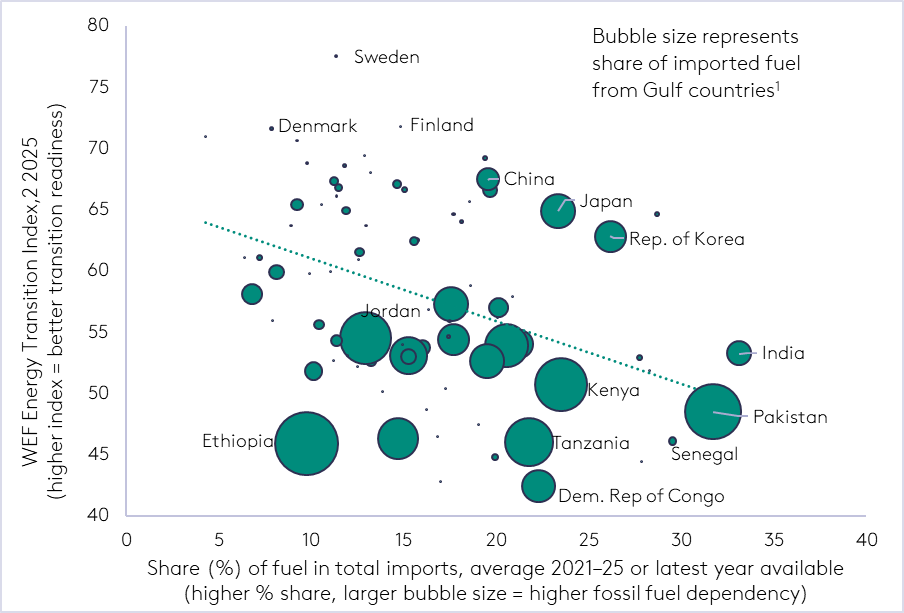
Notes: 1. Gulf countries include Bahrain, Iran, Kuwait, Oman, Qatar, Saudi Arabia and United Arab Emirates; 2. The ETI index is a scale from 0 to 100 scale and is based on 23 indicators of a country’s energy system performance in terms of security, equity and sustainability and 20 indicators of a country’s preparedness to support future energy needs in terms of regulation, infrastructure, capital and investment environment, human capital and innovation capacity (see WEF, 2025). Sample countries include net fossil fuel importers based on net fossil fuel trade data between 2021 and 2025.
Source: Authors based on data from World Integrated Trade Solutions and WEF (2025)
Why a just energy transition is necessary: the case of Pakistan
Pakistan entered the latest oil crisis in a weak position. Fuel accounts for one-third of the nation’s imported goods, with around 75% sourced from the Gulf countries (see Figure 1). Pakistan also carries high public debt (70.6% of GDP in FY 2025) and 50% of its foreign exchange reserves come from Middle East remittances. A series of shocks since 2020 have disproportionally affected the 84.3% of the nation’s workforce who are in informal employment and therefore lack employer protection. This is also reflected in the nation’s poverty rate, which rose from 18.3% in 2021 to 25.3% in 2024. The impact of the latest oil shock will be compounded by these pre-existing vulnerabilities.
Since the start of the Iran–US war, diesel prices have increased from 280 rupees per litre in March to 520.35 rupees per litre in April (an 85% jump). This will be directly eroding the incomes of low-income Pakistani households, who spend 17% of their incomes on energy. Since 80% of Pakistan’s fuel is used for transport, higher oil prices also directly feed into food prices, which further impacts household welfare, given food expenses account for 36.7% of budgets. Past oil price shocks also reveal possible welfare impacts. During the oil price shocks caused by the Russia–Ukraine war in 2022, petrol prices in Pakistan increased, driving food insecurity among urban households and increasing poverty among rural farm households.
Coping mechanisms used to counteract previous oil shocks reinforce the need for a large-scale just energy transition. Following the 2022 shock, solar imports and installation significantly increased in Pakistan, reaching an estimated 15% of households. However, solar uptake is highly unequal because of the upfront capital requirements. Higher-income consumers are therefore better able to transition to solar, while poorer households who cannot afford to do so remain locked into fossil fuel-based grid systems and exposed to ongoing price volatility. This demonstrates that without deliberately designing social policies for a just energy transition, fossil fuel dependence and coping mechanisms can entrench inequality.
At the macro level, in the midst of the Iran–US war, inflation is forecasted to have accelerated from 7.3% in March to 11.0–11.5% in April, which will squeeze Pakistan’s growth by reducing consumption and investment spending. The balance of payments could also worsen due to higher fuel import bills, trade disruptions (e.g. to shipping textiles for export), and a potential decline in remittance payments from Pakistani workers employed abroad. The government has responded with limited emergency relief measures using targeted fuel subsidies and austerity measures (e.g. instructing people to work from home and closing schools). To help finance these measures, the government has reallocated development funds for relief — creating a direct trade-off with sustainable development programmes. This constrains Pakistan’s chance to invest in climate mitigation and adaptation measures that build resilience; for instance, one study shows that if Pakistan invested in grid-scale batteries and wind energy, it could shield itself from volatile fossil fuel prices.
If it does not overcome the structural challenge of fossil fuel dependence through a just energy transition, Pakistan could be trapped in a vicious cycle of crises, creating greater public debt caused by measures to mitigate oil shock impacts, and a barrier to public investment in the energy transition. This will, in turn, expose the country to further oil price shocks in the future, with recurring disproportionate impacts on the most vulnerable groups in society.
Fossil fuel exporters are also not immune to the crisis: the case of Indonesia
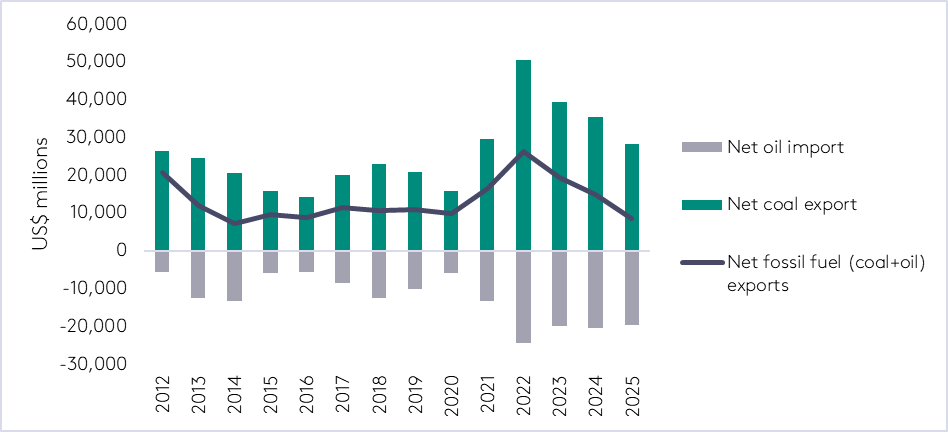
Indonesia’s situation is more complex. The country’s fossil fuel exports reached US$55 billion in 2024 (21% of the country’s total goods exports) and oil, gas and coal mining royalties contributed 7.5% of government revenue in 2019. The nation is also a net coal exporter and a net oil importer (see Figure 2), meaning that the oil price shock could bring export and revenue windfalls but also higher import costs, inflationary pressures and subsidy burdens. Crucially, Indonesia’s current policy responses to the oil price shock are potentially locking it into fossil fuel dependency, which puts the nation’s future socioeconomic and climate resilience under threat.
Figure 2. Indonesia’s net fossil fuel exports (exports minus imports), 2012–2025
Source: Authors based on data from World Integrated Trade Solutions and WEF (2025)
In response to the oil shock, Indonesia intends to expand its fuel subsidy budget by up to
Rp100 trillion (roughly US$6 billion) to shield domestic prices, at the expense of some government agencies in which spending cuts will be made. The government has also committed to maintaining low fuel prices by holding the current prices of subsidised fuel until the end of 2026. These actions follow a consistent pattern for Indonesia during oil crises: subsidies rise when oil prices rise, crowding out the budget available for spending on climate action (see Figure 3). Fossil fuel subsidies can also suppress the price signals that would otherwise encourage energy reform. These trade-offs have distributional effects. Fossil fuel subsidies disproportionately benefit higher-income Indonesian households and are an inefficient means of reducing poverty in comparison to direct transfers.
Figure 3. Energy subsidies versus climate expenditure in Indonesia, 2019–2023 (% of central government expenditure)
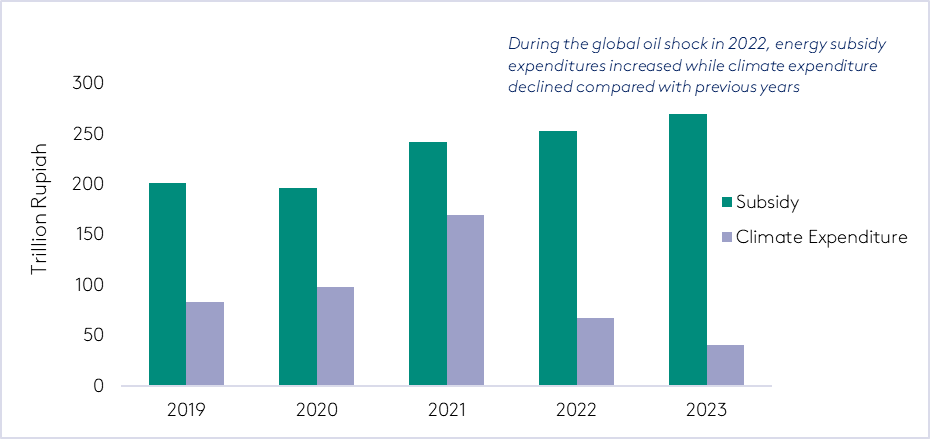
Notes: The 2022 subsidy figure understates the true burden because it captures only explicit line-item subsidies (Rp252.8 tn), not the implicit Pertamina/PLN compensation payments that brought the actual energy subsidy cost to roughly Rp551T that year.
Source: Authors, from Central Government Financial Report, Ministry of Finance and Annual Climate Budget Tagging Report.
To mitigate the impact of the current oil shock, Indonesia has responded with policies that conflict with just energy transition objectives. For instance, it has shifted some of its crude oil imports from the Middle East to the United States under its bilateral agreement, rather than expediting action to increase its clean energy capacity, such as through its 100 gigawatt solar and battery energy storage system programme. While imported crude oil and gas from the US may help mitigate short-term supply chain disruptions, it does not shield Indonesia from the current global oil price spikes since purchases are still priced on international benchmarks.
Indonesia is also reported to have been securing deals to develop both new renewable and fossil fuel projects, raising concerns that the latter could dilute Indonesia’s clean energy transition efforts. And the Indonesian government plans to expedite its biofuel programme which could save US$2.8 billion in subsidies, but palm-oil-based biofuels involve significant carbon emissions and also have just transition issues (e.g. rural livelihoods are affected by changing land use; smallholder farmers may lose land to biofuel projects without proper compensation).
Building resilience to oil shocks through just transitions
Oil shocks are not going away any time soon; but countries that transition away from fossil fuels in an inclusive manner can circumvent them. The oil crisis presents not only a warning about vulnerability but also an opportunity for resilience. Amid the crisis, the following actions may help accelerate the just transition:
1. Frame the just transition as energy security and resilience-building. The Iran–US war has revived the just energy transition as an energy security issue, not just a climate one. Denmark, Uruguay and the EU have shown the momentum that can be achieved from crises: 88% of Denmark’s electricity is provided by renewable sources, the result of its decisive energy reforms after the 1970s oil crisis. Uruguay’s reforms following the global financial and drought crises of 2008 have enabled 98% of its electricity to be sourced from renewables. In the EU, the Russia–Ukraine war paved the way for the Renewable Energy Directive in 2023 which increased the target for its share of renewables in the energy mix by 2030 from 32% to 42.5%. While the transition may be more challenging and expensive in middle- and low-income countries that have lower institutional, governance and technological capacities and limited access to finance, political momentum creates a window of opportunity for addressing the fundamental challenges of achieving a just transition and provides a strong signal for the international community to support domestic transition efforts.
2. Enable a whole-of-government approach to the just energy transition. Once the political momentum is set in motion, establishing an integrated framework for the just energy transition should be expedited. Just transition requires the integration of energy security, affordability and decarbonisation while at the same time protecting society’s most vulnerable groups (e.g. the poor, women, youth, informal workers and remote communities). A whole-of-government approach in developing, planning and implementing just transition frameworks will involve interdisciplinary expertise and contributions across government agencies (e.g. Ministries of Finance, Environment, Labour and Employment, Development Planning, Regional Development) and community participation. Supporting mechanisms such as institutional incentives, legislation, financing strategies and monitoring systems can help to lock in commitments and enable effective implementation. Several of these characteristics feature in Spain’s 2021 Climate Change and Energy Transition Law and the National Integrated Energy and Climate Plan.
3. Mobilise finance for the just energy transition. Strong frameworks for just energy transition will remain theoretical without a financing strategy to implement them, especially in low- and middle-income countries with limited capacity and resources. Energy transition comes at a cost, but this is front-loaded in comparison to the recurring economic and social costs of oil shocks. In this regard, a financial strategy will require exploring a mix of financing sources, including: savings from transforming blanket subsidies to targeted support, making sure that the most vulnerable are protected while savings from subsidies are reallocated for the just transition; using debt-for-climate swaps and GSS+ bonds; and creating policy incentives for financial institutions through transition plan disclosure requirements and prudential regulation that consider just transition. Once the domestic financing gap is ascertained, international finance that is long-term, concessional, flexible, catalytic and crisis-responsive can be mobilised, for instance through Just Energy Transition Partnership (JETP) grants alongside country platforms that are designed to coordinate public and private finance to support country-led just energy transition ambitions.
The authors would like to thank Rowan Conway, Liam Orme and Arka Chanda for comments on an earlier draft of this commentary.