


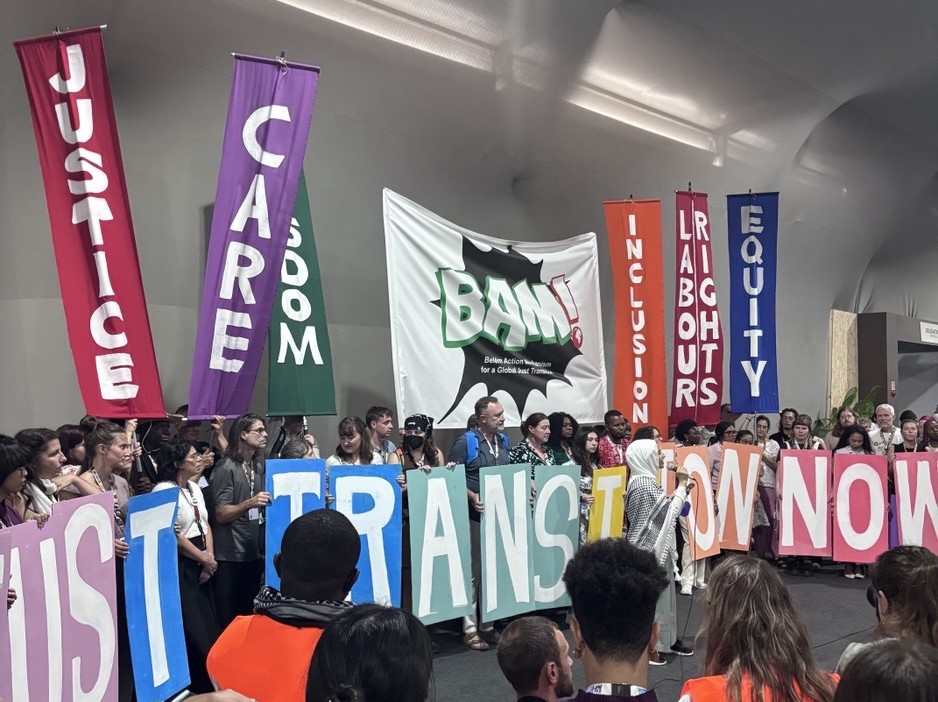
The Just Transition Mechanism agreed at the latest UN Climate Conference is a chance – perhaps our last – to prove that climate action can be ambitious and, lest we forget, human, writes Jodi-Ann Wang.
For all the headlines about deadlock and justifiable disappointment at COP30, something remarkable happened in the conference halls of Belém, Brazil. Countries agreed, for the first time, to create a mechanism on the just transition. It is a development that can shape how each of us experience the shift to a greener world. But what exactly does that mean?
‘Just transition’ may sound like abstract technical jargon, but the idea is quite simple. As the world moves away from fossil fuels, this should happen in an equitable way. Workers should have access to new jobs and skills; communities dependent on traditional, polluting sectors should have real, clean, economically viable alternatives. Indigenous peoples should have their established rights and sovereignty upheld. Women, young people, and marginalised groups should be protected. The costs of shifting to cleaner societies should not fall hardest on those who contributed the least to the crisis.
The just transition concept has been around for decades, championed by labour unions, Indigenous peoples and frontline communities long before our governments took it seriously. Until recently, it was a decorative frill on climate talks, not a core policy plank.
That began to change in 2022 when countries created the Just Transition Work Programme at COP27. Through two years of dialogue, countries shared challenges and visions for a fairer world. While talking is not enough and has delayed real work in many instances, these discussions did something important: they acknowledged that how we transition matters as much as how quickly we do it.
That insight is especially important as the global transition is no longer merely theoretical. From industries to households’ living costs and markets for different skills, societies and economies are shifting. Communities built around extractive sectors such as coal mining are facing uncertain futures. A just transition is not a moral add-on, but a practical necessity for ensuring that this move to a green economy does not deepen the inequities already felt in everyday life.
Building momentum for a mechanism at COP30
When negotiations became tense and agreement scarce at the conference in Belém, the just transition became one of the few topics where ambition and justice still connected to people’s experiences. For many developing countries, they could insist that moving away from fossil fuels must come with economic diversification and finance that does not worsen debt. For labour unions, Indigenous peoples and other rights-holders, it was a track where their rights can be etched into texts and formally recognised.
That political pressure, and the credibility crisis eating away at the multilateral system, propelled the idea of a global Just Transition Mechanism. At the conference, this Mechanism was first championed by civil society under the name the ‘Belém Action Mechanism’.
Practical implications
The mechanism is designed to create a single-entry point for countries and communities seeking support; improve access to technical assistance on labour policy, social protection and participatory planning; and help match needs with appropriate sources of finance, especially non-debt-creating ones. The latter point is especially critical at a time when many countries are already struggling with heavy debt burdens.
Most importantly, it embeds rights directly into transition planning, be it labour rights, Indigenous rights, human rights, or the right to a clean and healthy environment. This matters to all of us, but especially those who are already disenfranchised and living precarious lives.
This victory was hard fought. Wealthy nations such as the UK, Norway, Australia and Japan argued that a ‘mechanism’ would duplicate work, take too long to operationalise or raise unrealistic expectations. They preferred softer language, a simple ‘action plan’. But without a mechanism, the world risked producing yet another set of reports and roundtables, all of which are well-intentioned but detached from the realities of people whose livelihoods are already on the line.
What happens next?
In the end, the mechanism survived, though not in its more ambitious original form. References to the most contentious of issues – fossil fuels, critical minerals and unequal trade measures – were stripped out. These deletions reveal deeper structural issues of our world that are shaping climate politics: high levels of debt, entrenched corporate interests, and trade rules that disadvantage developing economies. The mechanism alone cannot resolve these systemic issues. But it does offer an institutional foothold for naming them, organising around them, and demanding better.
And this is where the story moves beyond COP30. The value of the Just Transition Mechanism will be measured not by the decision taken in Belém but by what happens next. Over the coming decade, every country will feel the effects of the energy transition (if that is not felt already), whether through changing industries, rising costs, new technologies, or shifting job and skills markets. A mechanism that protects people’s rights, livelihoods and dignity is not an abstract international detail. It is a tool for ensuring that climate action strengthens, rather than fractures, the social foundation we all rely on.
Belém opened the door. Whether the world walks through it will determine not only the fairness of the transition, but also its political durability. A green future built on social fracture will not hold, but a transition anchored in justice just might.